Amos Oz was born Amos Klausner in Jerusalem in 1939 but changed his name during adolescence after leaving home to live in a kibbutz, soon after his mother's death. He spent 31 years in an institution distrusted by his conservative parents, not merely for socialist principles but the movement seemed close to Stalinist ideologies, which had mostly not ended well for most Jews. Vigorous, idealistic, sunburned young(ish) workers strove together for a better world on collective farms.
This fascinating autobiography is primarily a story of a childhood spent in Palestine, which was divided with great bitterness from 1948 to form the newly-created state of Israel. This is understandable given the inevitable dispossession of Arabs who had owned and occupied the territory for 1900 years following the Diaspora. Theodor Herzl, a product of the Austro Hungarian Empire regarded as the main founder of Zionism, did not live to to see his idea become reality in what was the Ottoman Empire when he conceived it. He died in 1904, aged 44.
The Jews of Eastern Europe, who made up the majority of the new settlers, began to arrive in earnest from the late 1920s. Wikipedia suggests that in 1922 the Jewish population of Palestine was about 84,000 or 13%. It doubled in 10 years and by 1946 had reached 608,000. David Ben Gurion, who alarmed a 20-year old Amos by summoning him for an early morning chat. Amos had written a letter taking issue with an article about Spinoza by the veteran leader. In his memoir Oz agrees with Isaiah Berlin that Ben Gurion was a self-taught Polish peasant, not an intellectual. In 1948 Ben Gurion, who lived in Tel Aviv wrote in his diary his impressions of the Jews in Jerusalem:
"20% normal people, 20 privileged (university etc.), 60% weird (provincial, medieval etc.)."
Hundreds of thousand more refugees waited in camps for displaced persons in Europe. Many of those waiting for relatives to arrive in Palestine gradually concluded that their families would never arrive. Wikipedia estimates that the total world Jewish population prior to World War II was a little less than 17 million, of whom 6 million were systematically murdered.
Although the kibbutzim were mostly enthusiastic about returning to the land of their ancestors, the same cannot be said for Amos's family, Russian and Polish Jews who found living in much reduced circumstances in tiny flats in a hot, dusty alien country very unsettling. His maternal grandma Shlomit found the place filthy and full of germs, leading her to a sustained assault of cleaning and disinfection. Grandpa Alexander, her husband, loyally supported her in this campaign but after she died he resumed his lifelong preoccupation of charming and loving women, his secret being to listen attentively and give them the affirmation that they sought. He continued in this noble endeavour until his nineties, a man from Odessa of great charm and elegance.
Amos's mother and father were intellectuals, although in Jerusalem his mother was only able to teach a little privately, despite her degree from the University of Prague; his father worked for decades in the periodicals section of the university library. Amos was a precocious reader and lover of stories but it was only in Kibbutz Hulda that he found courage to write about ordinary people and places, inspired by the down home tales of Sherwood Anderson. It was also in the kibbutz that a very lovely and experienced older woman initiated him and enabled him to escape the torments of sexual feelings that filled him with guilt through adolescence.
There is a lot of repetition in this book, some no doubt for narrative effect, but it feels as though many other earlier essays have been stitched together. The translation from Hebrew by Nicholas de Lange is excellent. As so often the events of his childhood resonate down the years and the book returns again and again to his mother's suicide, in her thirties. His father's parallel infidelities and early remarriage also affected him deeply.
Thursday, 13 July 2017
Thursday, 15 June 2017
2017/30 Anthony Quinn: The Rescue Man (2009) **
Anthony Quinn is a Liverpudlian author and freelance writer. He studied classics at Pembroke College, Oxford and is married to fellow Oxford Graduate Rachel Cooke, also an author and journalist. This was his first novel and it contains some striking ideas.
We do not perhaps think much about the extreme dangers faced by civilian rescue workers during the Blitz and Quinn vividly describes the gutted and collapsing buildings from which the hero, Tom Baines, works with others to search for and to rescue those trapped inside. The Luftwaffe bombed UK towns and cities heavily in 1940 and 1941 and Liverpool's dominance as a major port generated the heaviest bombing outside London. Although it is not mentioned in the book, the northern docks, close to Bootle had some of the most aggressive bombardment. These were the deepest docks, able to accommodate the largest vessels in the North Atlantic convoys, as well as warships and troop ships. The Liverpool Echo reported that 80% of Bootle's housing suffered bomb damage or caught fire.
Quinn's interest in the history of Liverpool's buildings forms another strand of the plot, greatly appealing to this building enthusiast, who has worked in Liverpool on and off for over thirty years. Nevertheless the book at times reads like a gazetteer, rather than a novel. Tom Baines is also an architectural historian, regularly putting off his work on a publisher-commissioned history of Liverpool's buildings, as he copes with his personal anxieties, mostly to do with women and being an orphan. He takes up with Richard, a photographer and veteran of the Great War, in a flurry of record photography before the bombing starts. He falls for Richard's much younger artist wife Bella.
A parallel 19th Century sub-plot, based on some not entirely convincing diaries, describes the rise and early death of a brilliant young architect, Peter Eames, whose ideas and buildings were ahead of their time as a result of his extensive use of glass and steel, in particular an early form of curtain walling. This is a barely disguised reference to Peter Ellis, who was much longer-lived (1805-1884) and whose best known, and very fine, buildings are shown below.
Liverpool has more than 2,500 listed buildings, the largest number of any UK city apart from London. From my own experience, a significant proportion of these struggle to find a modern use or the funding to enable it. It is a fascinating city and Quinn's love for it is transparent, although he has some ambiguity about Liverpudlians and has remained in the South East.
This book was recommended to me and it is perhaps as well that I did not read Frank Cottrell Boyce's unfavourable Guardian review first because I am inclined to agree with him on most points. https://www.theguardian.com/books/2009/jan/10/anthony-quinn-rescue-man
Many passages are overwritten and the repeated references to literature, especially Shakespeare, are clumsy and self-conscious, without being illuminating. Quinn likes a cliche and Cottrell Boyce is right that a couple of passages are candidates for the bad sex award. Quinn thanks his editor but it seems that this was editing lite, in the modern manner, or possibly we see what was left after the worst excesses were red-lined. There is a better book struggling to get out. There are lots of good ideas and good passages, during which I managed to forgot the weakness of the prose. Quinn has continued to have more historical novels published and it seems likely that he will have developed his craft.
We do not perhaps think much about the extreme dangers faced by civilian rescue workers during the Blitz and Quinn vividly describes the gutted and collapsing buildings from which the hero, Tom Baines, works with others to search for and to rescue those trapped inside. The Luftwaffe bombed UK towns and cities heavily in 1940 and 1941 and Liverpool's dominance as a major port generated the heaviest bombing outside London. Although it is not mentioned in the book, the northern docks, close to Bootle had some of the most aggressive bombardment. These were the deepest docks, able to accommodate the largest vessels in the North Atlantic convoys, as well as warships and troop ships. The Liverpool Echo reported that 80% of Bootle's housing suffered bomb damage or caught fire.
Quinn's interest in the history of Liverpool's buildings forms another strand of the plot, greatly appealing to this building enthusiast, who has worked in Liverpool on and off for over thirty years. Nevertheless the book at times reads like a gazetteer, rather than a novel. Tom Baines is also an architectural historian, regularly putting off his work on a publisher-commissioned history of Liverpool's buildings, as he copes with his personal anxieties, mostly to do with women and being an orphan. He takes up with Richard, a photographer and veteran of the Great War, in a flurry of record photography before the bombing starts. He falls for Richard's much younger artist wife Bella.
A parallel 19th Century sub-plot, based on some not entirely convincing diaries, describes the rise and early death of a brilliant young architect, Peter Eames, whose ideas and buildings were ahead of their time as a result of his extensive use of glass and steel, in particular an early form of curtain walling. This is a barely disguised reference to Peter Ellis, who was much longer-lived (1805-1884) and whose best known, and very fine, buildings are shown below.
| Oriel Chambers, Water Street, Liverpool, courtesy of Wikipedia |
| 16 Cook Street, Liverpool, courtesy of Wikipedia |
This book was recommended to me and it is perhaps as well that I did not read Frank Cottrell Boyce's unfavourable Guardian review first because I am inclined to agree with him on most points. https://www.theguardian.com/books/2009/jan/10/anthony-quinn-rescue-man
Many passages are overwritten and the repeated references to literature, especially Shakespeare, are clumsy and self-conscious, without being illuminating. Quinn likes a cliche and Cottrell Boyce is right that a couple of passages are candidates for the bad sex award. Quinn thanks his editor but it seems that this was editing lite, in the modern manner, or possibly we see what was left after the worst excesses were red-lined. There is a better book struggling to get out. There are lots of good ideas and good passages, during which I managed to forgot the weakness of the prose. Quinn has continued to have more historical novels published and it seems likely that he will have developed his craft.
Sunday, 11 June 2017
2017/28 Peter Bill: Planet Property (2013) ****
Peter Bill was the editor of the Estates Gazette from 1998-2009, after six years as editor of Building magazine and a previous career as a quantity surveyor. Property has long been subject to cycles of boom and bust and his tenure at the EG was particularly thrilling because it included the most spectacular cycle since the 1930s. The book includes extracts from interviews with many key figures in the property world, including veteran developer Gerald Ronson who said, "Unless we get a dose of inflation it will take the banks ten years to work through their losses." We didn't get much inflation, interest rates have been sustained at unprecedented low levels and the banks are still struggling to rebuild their balance sheets.
A gathering frenzy amongst banks to lend too much, with little caution, is nothing new. Two predecessor books, both by financial journalists, told the story from the 1930s onward. Oliver Marriott's 1968 classic The Property Boom focuses on the key players involved in the long boom from 1945. Alastair Ross-Goobey, also an investment fund manager charts the crash of 1972 as well as that of 1989-90 in Bricks and Mortals, with some particularly good interviews and profiles.
I found these huge market fluctuations and the fortunes won and lost completely fascinating as soon as I entered the world of property in 1977. Peter Bill does a good job in condensing what he learned and experienced in the subsequent period into a pretty well-focused account. At times it feels like a collection of his leaders but those were his key thoughts about the issues of the day and his use of them is understandable. Perhaps most fascinating for the non--property person is his explanation of how Planet Property works. Property folk are very sociable and in what he states to have been the best job ever, he attended perhaps three thousand breakfasts lunches, cocktail parties and dinners, truly putting his liver on the line in the cause of journalism. And he got to go to some very fancy restaurants and to drink some outstanding wines. He concludes that the property world is still very closed and male-dominated, to its ultimate disadvantage. His explanation of the pecking order within the estate agency world particularly well and highlights the taboo of referring to commercial property agents as "estate agents," a term reserved for house agents.
Alcohol still plays an important part but younger property people spend a lot more time in front of a screen than at the pub and the world of large surveying firms changed enormously as a result of Big Bang and the unstoppable waves of global investment that crashed upon the UK market from the late 1990s, particularly from the United States. This pressure catalysed many mergers and distorted the market, compressing investment yields well below long term trends. There is a paradox with investment yields: the lower they are, the more the investment is worth. The effect occurs relatively rapidly because there are a relatively small number of modern, high quality investment properties. Shrewd investors sell when the price becomes unrealistically high and new investors eventually get burned.
Philip Green is revealed as pretty much the obnoxious bully that we might have expected, Sir John Ritblat's detestation of too-clever-by-half young analysts seems perfectly reasonable and Mike Slade of Helical Bar comes out of it as a very shrewd cookie but also a very nice chap. A most enjoyable read and nicely modest, with the wryness of an outsider looking in.
A gathering frenzy amongst banks to lend too much, with little caution, is nothing new. Two predecessor books, both by financial journalists, told the story from the 1930s onward. Oliver Marriott's 1968 classic The Property Boom focuses on the key players involved in the long boom from 1945. Alastair Ross-Goobey, also an investment fund manager charts the crash of 1972 as well as that of 1989-90 in Bricks and Mortals, with some particularly good interviews and profiles.
I found these huge market fluctuations and the fortunes won and lost completely fascinating as soon as I entered the world of property in 1977. Peter Bill does a good job in condensing what he learned and experienced in the subsequent period into a pretty well-focused account. At times it feels like a collection of his leaders but those were his key thoughts about the issues of the day and his use of them is understandable. Perhaps most fascinating for the non--property person is his explanation of how Planet Property works. Property folk are very sociable and in what he states to have been the best job ever, he attended perhaps three thousand breakfasts lunches, cocktail parties and dinners, truly putting his liver on the line in the cause of journalism. And he got to go to some very fancy restaurants and to drink some outstanding wines. He concludes that the property world is still very closed and male-dominated, to its ultimate disadvantage. His explanation of the pecking order within the estate agency world particularly well and highlights the taboo of referring to commercial property agents as "estate agents," a term reserved for house agents.
Alcohol still plays an important part but younger property people spend a lot more time in front of a screen than at the pub and the world of large surveying firms changed enormously as a result of Big Bang and the unstoppable waves of global investment that crashed upon the UK market from the late 1990s, particularly from the United States. This pressure catalysed many mergers and distorted the market, compressing investment yields well below long term trends. There is a paradox with investment yields: the lower they are, the more the investment is worth. The effect occurs relatively rapidly because there are a relatively small number of modern, high quality investment properties. Shrewd investors sell when the price becomes unrealistically high and new investors eventually get burned.
Philip Green is revealed as pretty much the obnoxious bully that we might have expected, Sir John Ritblat's detestation of too-clever-by-half young analysts seems perfectly reasonable and Mike Slade of Helical Bar comes out of it as a very shrewd cookie but also a very nice chap. A most enjoyable read and nicely modest, with the wryness of an outsider looking in.
Saturday, 10 June 2017
2017/27 Agatha Christie: The Murder of Roger Ackroyd (1926) **
Agatha Christie's books are reckoned to be the third best-selling titles of all time after the Bible and Shakespeare. According to Wikipedia, that oracle of co-operative encyclopedism, Christie published 66 detective novels and 14 short story collections. They have rather a good picture of her as a girl.
Guinness World Records lists her books as having sold 2 billion copies around the world and the Index Translationum (who knew?) states that she has been translated into 103 languages. Given this unassailable evidence of her global popularity, perhaps I was missing something. In my 20s I tried at least three times to read a paperback copy of The ABC Murders, only to cast it aside as a lot less than thrilling. Perhaps, in mature years I might enjoy one of Christie's most famous novels. I lashed out £2.99 to Google Play for the 377 page e book.
![]() |
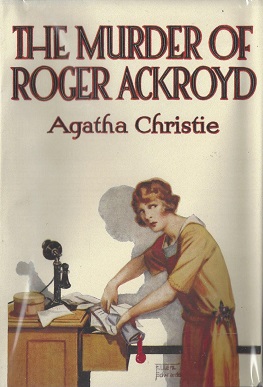
| Cover of first edition hardback, courtesy of Wikipedia |
I finished the book quickly and I certainly did want to know who did it. So far, so good. This is a country house murder mystery, investigated by the Ackroyd family doctor and, improbably, by his next door neighbour, Hercule Poirot, who has, also improbably, retired to the country to grow vegetable marrows. And, to digress, why the prefix vegetable? Perhaps it distinguishes them from bone marrow. Christie was brought up in an upper middle class family in Torquay and paints a picture of prosperous villages and evening Mah Jong parties, attended by rambling Colonels retired from the Raj and gossip-hungry spinsters. One Ackroyd house guest is Major Blount, a big game hunter.
This is no doubt a world that she knew well, although by the time the book was published in 1926 she was living at Sunningdale in Berkshire . In December that year her husband Archie asked for a divorce to marry a younger woman, Nancy Neele. Agatha famously disappeared and was discovered in the Swan Hydropathic Hotel in Harrogate after front page press coverage in the UK and even in the New York Times.
Roger Ackroyd's story is told from the first person standpoint of Doctor Sheppard, revealing multiple motives and secrets of the protagonists, both the servants and the relatives who hope to inherit the wealth of this self-made manufacturer. Cocaine sniffing, illegitimate children and blackmail play their parts and this is clearly a staid world of haves and have nots, in which too many people have too little to do. The sense of resentment by the servants of their precarious social position is nicely realised. The story only comes alive when Poirot appears and he is certainly a creation of genius, even if his eccentric mode of speech is not always consistently applied. It is useful to have a detective who has licence to be abrupt and unconventional in dealing with the protagonists. I expect that the inverse is true of Miss Marple.
This story is cleverly put together, although the reveal has remained controversial, and Poirot is entertaining, but life is too short to eat bad food, drink poor wine or to read Agatha Christie. All the same I am always happy to watch David Suchet's outstanding portrayal of Poirot.
Friday, 9 June 2017
2017/29 Iain Bamforth: A Doctor's Dictionary (2015) ****
This collection of longer form journalism by a Scots doctor, poet, translator from French and German and lecturer in comparative literature is extremely varied, reflecting his many interests. It is assembled under the initial letters of the topics covered, probably for want of any other unifying theme. Bamforth is one of those extremely clever literary coves who happily wanders between science and the arts. Bertram Wooster would have recognised the type: noble intellectual forehead and the predominance of fish in the diet. Indeed several of his pieces stretched me to the limits of my slender intellect. His wife is German and he has practised as a GP in Strasbourg but he also describes the year that they spent in Broken Hill, including his visit to deep underground workings, the history of toxic dust and the dire climate. Broken Hill has been staggeringly profitable from the beginning and only this week I was reminded that Australia never suffered recession from the global financial crisis, largely because of the insatiable Chinese demand for its mineral reserves.
Bamforth loves Stendhal, Kafka, Thomas Mann, Rabelais and many others. An amusing chapter covers Kafka's fondness for his uncle, a country doctor and one of the first motor bike owners in Austria Hungary. Tuberculosis is another theme: its 19th Century associations with heightened sexuality and the Swiss sanatoria, as described in Thomas Mann's The Magic Mountain. This particular market for health tourism dried up fairly rapidly after 1943 when Albert Schatz discovered streptomycin. Researchers estimate that around a third of people on the planet have been exposed to TB and the incidence of the disease is higher than it has ever been in total numbers affected.
Essays also cover the importance of careful looking and the dominance of sight over the other senses, the impetus to the Enlightenment given by taxonomy and the illustration of anatomy, including the Plastinator, Professor Doktor Gunter von Hagens. The "von" is apparently an affectation on the part of this master showman whose gruesome tableaux of flayed humans and animals were included in spectacularly profitable exhibitions from the 1990s. This is a fascinating book and it is uplifting to find someone so continually curious and unwilling to be pigeonholed.
Bamforth loves Stendhal, Kafka, Thomas Mann, Rabelais and many others. An amusing chapter covers Kafka's fondness for his uncle, a country doctor and one of the first motor bike owners in Austria Hungary. Tuberculosis is another theme: its 19th Century associations with heightened sexuality and the Swiss sanatoria, as described in Thomas Mann's The Magic Mountain. This particular market for health tourism dried up fairly rapidly after 1943 when Albert Schatz discovered streptomycin. Researchers estimate that around a third of people on the planet have been exposed to TB and the incidence of the disease is higher than it has ever been in total numbers affected.
Essays also cover the importance of careful looking and the dominance of sight over the other senses, the impetus to the Enlightenment given by taxonomy and the illustration of anatomy, including the Plastinator, Professor Doktor Gunter von Hagens. The "von" is apparently an affectation on the part of this master showman whose gruesome tableaux of flayed humans and animals were included in spectacularly profitable exhibitions from the 1990s. This is a fascinating book and it is uplifting to find someone so continually curious and unwilling to be pigeonholed.
Monday, 5 June 2017
2017/26 Paul Beatty: The Sellout (2015) ***
This won the Man Booker Prize in 2016 and it is a novel of great wit, which riffs on being black, indeed being a nigger, raised by a social scientist father on an urban farm in Dickens, a ghetto community in southern Los Angeles. His father's harsh regime carrying out social experiments on his son provided some laugh-out-loud moments but overall it was mostly occasional wry smiles, rather a lacklustre response compared with those of the many well known fans cited over several pages. A clever writer but for me the book was oversold.
Friday, 2 June 2017
2017/25 John Grisham: A Time To Kill (1989+92) ***
Listless from a stomach bug, I lost myself in this John Grisham, an easy and compelling author for those under the weather. I was drawn on by the story but this, his first novel, left me unsettled. All the characteristic elements of his legal thrillers are here: beautiful anodyne wife, young lawyer battling the profession/other lawyers/the forces of evil, preppy fashion choices and so on. It sold reasonably well in the local area but no great shakes and was reissued with massively greater sales after the runaway success of his breakthrough novel, The Firm in 1991.
I came across that book as a giveaway in the days when P&O Properties encouraged me to travel to London First Class, on a service that was branded "Pullman" but in reality offered nothing close to that legendary standard. I had intended to work on the return journey but opened the free copy of the novel and was still reading when I reached Preston. Since then we have read perhaps a dozen of his novels when we felt the need for escapism. The combination of convincingly accurate legal procedure and compelling stories of the weirdness and venality of America are hard to resist. The solid but uninspired prose is easily forgiven. I couldn't write these novels and Grisham has been outstandingly successful.
The story is set in the 1980s and it is easy to forget that Martin Luther King's "I have a dream" speech was only 20 years' beforehand. The Jim Crow Laws were formally abandoned in 1965 and attitudes slowly changed. The novel assumes, no doubt accurately, that if a white father shot a black man for raping his daughter, he would be acquitted by a predominantly white jury. Grisham pushes to the limits the mirror image crime to see whether Mississipi has moved on sufficiently to acquit a black man of the same charges. Confrontation between highly organised black churches and the Ku Klux Klan wind up the tension, resulting in the mayor's being obliged to call in the National Guard. The oppressively humid July weather increases the tension further and flaming crosses, beatings, jury intimidation and the burning of our lawyer hero Jake Brigance's much-loved and carefully restored Victorian house set the scene for the expected tense courtroom drama.
It is perhaps 25 years since I first read this novel, although I have seen the Matthew McConaughey and Samuel L Jackson film since then. This time I found the prejudice and traditions of the South freshly shocking and although our lawyer hero Jake Brigance is comfortable with black folks and wants to fight for their rights, there is a strong sense that what matters most is winning his case and boosting his reputation. His attitude to women is traditional and he does not want a wife who is independent and career-minded. It is important for him to be the provider and he will bend the law and practice to win work and to win cases. This is not To Kill a Mockingbird and Jake is not Atticus Finch. He makes it clear that previous generations of small town lawyers used their position to accumulate money and property to the disadvantage of their clients and that old prejudices continue to die hard.
The book is too long at 515 pages and needed further editing. In the introduction to the 1992 reissue, the author writes that the novel is significantly autobiographical. His hero, Jake Brigance, is a small town Southern street lawyer. Grisham only practised law for ten years, in a small firm in Oxford Mississipi, where he was born and brought up. He is a man of the South. I came away with the feeling that Grisham is not too far from being a good ol' boy himself.
I came across that book as a giveaway in the days when P&O Properties encouraged me to travel to London First Class, on a service that was branded "Pullman" but in reality offered nothing close to that legendary standard. I had intended to work on the return journey but opened the free copy of the novel and was still reading when I reached Preston. Since then we have read perhaps a dozen of his novels when we felt the need for escapism. The combination of convincingly accurate legal procedure and compelling stories of the weirdness and venality of America are hard to resist. The solid but uninspired prose is easily forgiven. I couldn't write these novels and Grisham has been outstandingly successful.
The story is set in the 1980s and it is easy to forget that Martin Luther King's "I have a dream" speech was only 20 years' beforehand. The Jim Crow Laws were formally abandoned in 1965 and attitudes slowly changed. The novel assumes, no doubt accurately, that if a white father shot a black man for raping his daughter, he would be acquitted by a predominantly white jury. Grisham pushes to the limits the mirror image crime to see whether Mississipi has moved on sufficiently to acquit a black man of the same charges. Confrontation between highly organised black churches and the Ku Klux Klan wind up the tension, resulting in the mayor's being obliged to call in the National Guard. The oppressively humid July weather increases the tension further and flaming crosses, beatings, jury intimidation and the burning of our lawyer hero Jake Brigance's much-loved and carefully restored Victorian house set the scene for the expected tense courtroom drama.
It is perhaps 25 years since I first read this novel, although I have seen the Matthew McConaughey and Samuel L Jackson film since then. This time I found the prejudice and traditions of the South freshly shocking and although our lawyer hero Jake Brigance is comfortable with black folks and wants to fight for their rights, there is a strong sense that what matters most is winning his case and boosting his reputation. His attitude to women is traditional and he does not want a wife who is independent and career-minded. It is important for him to be the provider and he will bend the law and practice to win work and to win cases. This is not To Kill a Mockingbird and Jake is not Atticus Finch. He makes it clear that previous generations of small town lawyers used their position to accumulate money and property to the disadvantage of their clients and that old prejudices continue to die hard.
The book is too long at 515 pages and needed further editing. In the introduction to the 1992 reissue, the author writes that the novel is significantly autobiographical. His hero, Jake Brigance, is a small town Southern street lawyer. Grisham only practised law for ten years, in a small firm in Oxford Mississipi, where he was born and brought up. He is a man of the South. I came away with the feeling that Grisham is not too far from being a good ol' boy himself.
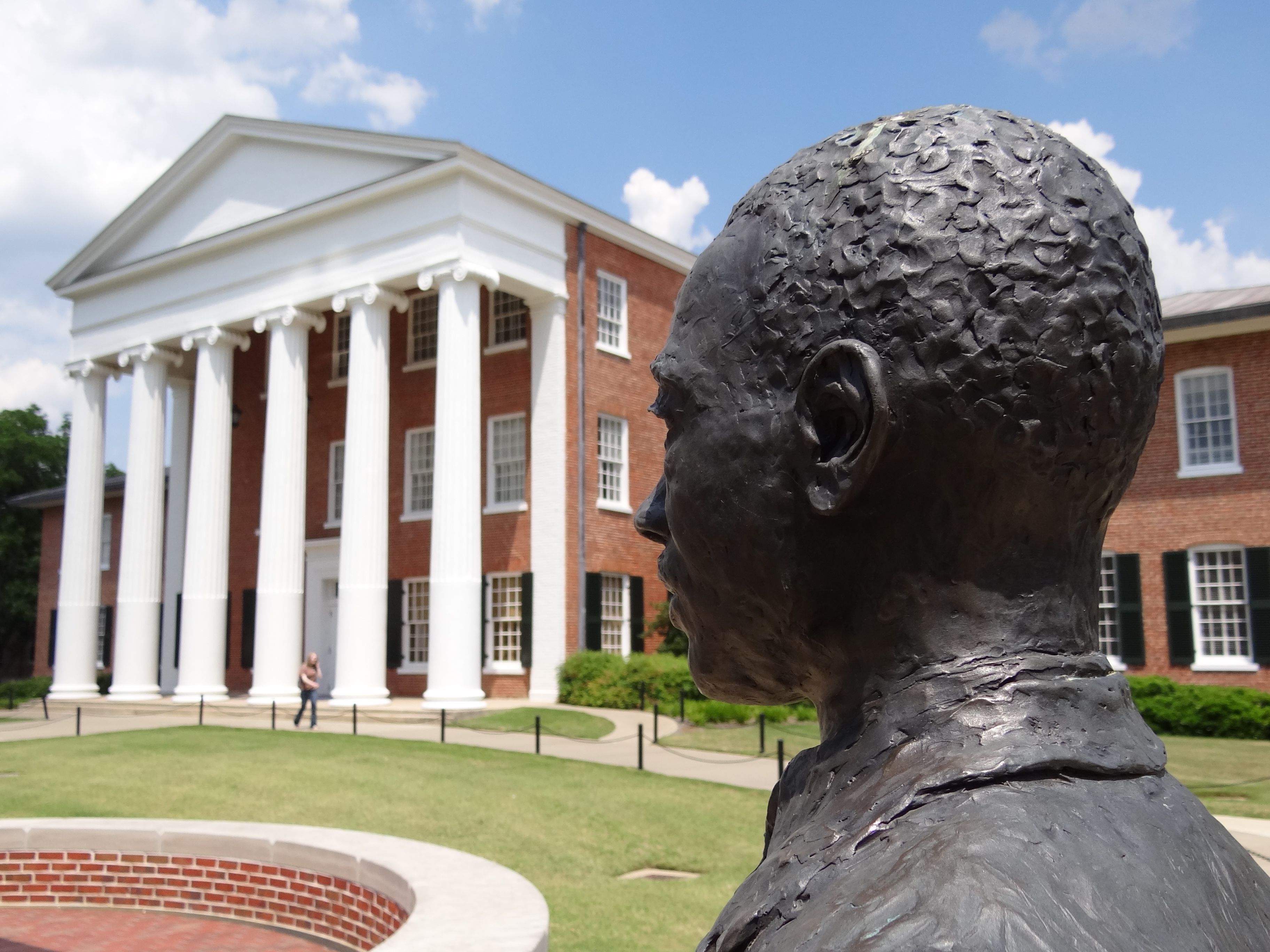
Ol Miss, Oxford Mississipi, monument to James Meredith who desegregated the university.
Image courtesy of Wikimedia Commons
Tuesday, 30 May 2017
2017/24 Michael Williams: On The Slow Train (2012) ***
It may be that four stars is a little niggardly. This is a very enjoyable, and enjoyably slender, book, written whilst Williams was lecturing in the department of journalism at The University of Central Lancashire in Preston, where Cath taught in the Business School for 11 years. Williams is a journalist who held senior positions with the Independent and The Sunday Times but managed to fit in regular journalism about railways, a lifelong love. This joy and extensive knowledge underpins the commentary on all of the journeys related here. I was reminded of Christian Wolmar, another railway journalist, without his polemicism.
The journeys described range from the former tube trains on the Isle of Wight to the St Erth and St Ives line in Cornwall. He travels on the 8:04 from Norwich along the Suffolk coast and on the Cumbrian coast line via Grange-over-Sands and Sellafield. Most memorable perhaps were the steam excursion to Canterbury and the West Highland line via Rannoch Moor. I was certainly left eager to take the journeys myself.
I spoke to my father last night about our intended move to Berwick-upon-Tweed and when I explained that being in walking distance of a railway station is a priority for us, it was clear that there was no meeting of minds. He is a creature of the motor age for whom cars have always been an interest and a status symbol. has never been a rail traveller and our local line from Selby to Bridlington was a victim of the Beeching cuts. I can quite see that for farmers' sons the motor car opened up the world and gave speed and relative luxury but my reaction was a little different. I too found being in the middle of nowhere isolating but having to use the car for each and every external need seemed unsatisfactory, wasteful and inefficient. Perhaps I just like walking more than some and to walk or cycle to a railway station opens up a world of possibilities. The huge growth in rail travel over the last 20 years suggests that we have rediscovered our railways and Michael Williams is all for that.
The journeys described range from the former tube trains on the Isle of Wight to the St Erth and St Ives line in Cornwall. He travels on the 8:04 from Norwich along the Suffolk coast and on the Cumbrian coast line via Grange-over-Sands and Sellafield. Most memorable perhaps were the steam excursion to Canterbury and the West Highland line via Rannoch Moor. I was certainly left eager to take the journeys myself.
I spoke to my father last night about our intended move to Berwick-upon-Tweed and when I explained that being in walking distance of a railway station is a priority for us, it was clear that there was no meeting of minds. He is a creature of the motor age for whom cars have always been an interest and a status symbol. has never been a rail traveller and our local line from Selby to Bridlington was a victim of the Beeching cuts. I can quite see that for farmers' sons the motor car opened up the world and gave speed and relative luxury but my reaction was a little different. I too found being in the middle of nowhere isolating but having to use the car for each and every external need seemed unsatisfactory, wasteful and inefficient. Perhaps I just like walking more than some and to walk or cycle to a railway station opens up a world of possibilities. The huge growth in rail travel over the last 20 years suggests that we have rediscovered our railways and Michael Williams is all for that.
Thursday, 25 May 2017
2017/23 Charles Dickens: Bleak House (1853) ****
Bleak House is often cited as Dickens' finest novel. I have started it a couple of times previously but cast it aside in irritation at the baggy prose and comic characters that I find not in the least amusing. Sense of humour is indeed a very personal matter. Dickens is also famous for his wonderful inventiveness in naming characters but often their names are as irritating as they are. This tendency is reminiscent of the wince-making quality of names in second-rate fantasy and science fiction. Harold Skimpole behaves like a child and is clearly a specialised kind of narcissist, probably drawn from life and a quite appalling person, husband and father but we hear more of him at greater length than I can readily cope with. The prolixity probably stems in part from publication as a serial: the deadlines and Dickens' fame would have permitted little editing.
The compelling formula of mysterious origins, wills and inheritance drives the narrative and we always wanted to find out more. I also admit to shedding a tear at the death of Jo, the crossing sweeper, despite the characteristic mawkishness. Dickens was a great walker and a couple of recent articles mentioned that he walked to help him think but in the process he came to know the byways of London in great detail, giving him the keenest awareness of filth and degradation but also of the immense gap between rich and poor. This is very much a novel outraged at that contrast and we read of the stately life of Sir Leicester Dedlock, whose seat at Chesney Wold in Lincolnshire is much described. Dickens seems inclined to view the rural village an idyll that contrasts favourably with the urban slime and squalor of the Great Wen. The Dedlocks also have a Georgian town house, essential for Parliament and for The Season, although Lady Honoria Dedlock disdains the social round by the period in which the novel is set. She is a noted beauty, much younger than her husband and Dickens makes repeated mention of her celebrity amongst those who read about it. Nothing new under the sun, it seems. However, Sir Leicester's devotion to her is genuinely touching. He would clearly have forgiven the shameful events of her early life.
The novel has dual narration, by an authorial voice but also, rather breathlessly, by Esther Summerson (Dickens sole female narrator) whose largely loveless childhood is succeeded by a somewhat sickeningly delightful life with her guardian, John Jarndyce, who has sensibly eschewed involvement in the complex inheritance battle Jarndyce and Jarndyce, which comes to blight the life of his other two wards. Dickens had a good understanding of and fascination with the law of inheritance, which had long been in need of reform. The Court of Chancery and this turgid legal battle is at the heart of the novel and produces some very fine writing. Another key character is also a lawyer. Mr Tulkinghorn is an eminent member of Lincoln's Inn, whose duty is to protect the interests of that noble house, the Dedlocks. Dickens' description of the solitary and omniscient lawyer descending to his cellar to select a bottle of ancient port for private pleasure is memorable.
The plot is complex with several strands and there are many characters. Dickens manipulates them deftly and I found no sign that he lost track over 19 monthly instalments. There was controversy over his inclusion of an incident of spontaneous combustion as a plot point but he had researched the matter and defended the issue against his critics. Internet searches suggest that it remains very controversial and instances cited tend to appear on websites associated with the paranormal, including one relating to Wilfrid Gowthorpe of Pocklington which I came across some years ago.
Giving star ratings to works of art is a modern habit that is doubtless despised by many persons of letters but I find it a useful way of sorting sheep from goats; since we know not the day nor the hour, time spent on poor books is time wasted. This is a fine book, notwithstanding the various criticisms that I have made. Ultimately I am more of a Trollope man than a Dickens man but I wish that I could write so well and Dickens at his best is outstanding.
Wednesday, 12 April 2017
2017/22 Max Porter: Grief is the Thing With Feathers (2015) ***
A bereaved husband with two boys is laid low by grief and rescued by Crow, an initially unwelcome visitor arising from his Ted Hughes obsession. A short, robust, poignant blend of poetry and prose. How powerfully the legends of Hughes and Plath continue to be. Today's Guardian has a front page story of newly uncovered letters from SP to her therapist, Ruth Barnworth, supposedly revealing his abuse and violence but, if I remember correctly, she claimed to have bit him savagely on the cheek the first time they danced and she seems to have been a few slates short of a lean-to. Or maybe I'm just an appalling old mysogynist, soured by finding The Bell Jar a dispiriting tale of the self-obsessed.
https://www.faber.co.uk/9780571327232-grief-is-the-thing-with-feathers.html
2017/18 Ottessa Moshfegh: Eileen ****
It is always a delight to encounter a new, different and confident voice, often a woman, and you ask yourself how they managed to think their way into the being of the protagonist. Imagination is indeed a remarkable thing. Eileen is a screw up, pretty much despised by her sick and now dead mother and failing to look after her half-crazed retired, Catholic, small town alcoholic cop of a father. Eileen works at the juvenile prison for boys and the scenes with her appalling co-workers are very rich in grim detail. There is much wit and some laugh-out-loud moments.
Madness and obsession are never far away and the sordid is meat and drink to Moshfegh, who is the daughter of professional musicians from Iran and Croatia, who settled in Boston, Massachusetts. I don't spend too much time exploring the background of writers but I like to know something about them. She does seem to have been a tortured teen, probably with a rich inner life and writing seems to have been her way back. She wrote Eileen because she needed the money and decided to knock out a psychological thriller and see how far she could push things. This is a confident and absorbing novel, with some great twists and turns and an excellent sense of small town life in the 1960s.
2017/17 John Updike: Rabbit Run (1960) ****
Having never previously got round to John Updike, this was a late first. It is a novel of details and at its finest the writing seems unique, at least to me: the very early description of Harry, Rabbit Angstrom's encounter with the kids playing basketball is particularly striking. He nails what it must be like to harness the physical and mental skills required to play confidently and well. The descriptions elsewhere are exact and closely observed; uneasy passages relate Harry's discontent with his marriage and inklings that maybe being a high school basketball star is as good as it may be going to get. The blind date in the company of his former coach is pretty queasy and the shocking downfall of his alcoholic wife is tragic and theatrical. The overall sense is of an unusual mind, exploring the norms and constrictions of small town life, with a strong sense of class, the pecking order and the proximity of religion. Episcopalianism comes out of it as spineless do-goodery.
Tuesday, 4 April 2017
2017/21 Robert Penn: It's All About the Bike (2010) ****
An excellent little book, which was made into a TV series; he uses the selection of components and elements of his dream bike as a framework on which to hang anecdotes, cycle history, technology, and visits to the factories and workshops of specialists. Most are fanatics like Rob who has cycled round the world and used his many bikes on endless expeditions and adventures. His origins on the Isle of Man are touched on, including naming his round the world bike Mannaman after the Manx warrior god of legend. We learn the origins of the mountain bike in Marin County California as a development from the 1930s balloon-tyred cruiser bikes. This all started around 1973 and was a very laid back hippy carry on. A far cry from the Campagnolo works and the Continental tyre factory in Germany.
And what an excellent machine the bicycle is, the most efficient frame still essentially the same as that invented by Coventry genius John Kemp Starley in 1885. I was impressed that Rob has managed to make the switch from being a lawyer to making a living out of his writing on cycling from his Black Mountain fastness above Abergavenny.
2017/20 Colleen McCullough: The Thorn Birds (1977) ***
Although this is a long family saga it is compelling and redolent of place and time. Colleen McCullough's knowledge and appreciation of the Australian outback is vivid and impressive. She is fearless in killing off her creations and the dominance of the Catholic church in Australia is a major theme but she shies away from dealing with its more sinister and abusive history. The female characters are strong, as might be expected, and the scenes in the New Zealand primary school run by Catholic nuns is vividly realised around the central character of Meggie. Her affair much later with Irish Catholic priest Ralph (Rafe) de Bricassart is central to the story, although he is perhaps a little too handsome, charming and athletic to be entirely believable.
The descriptions of landscape and weather are somewhat overwritten but by and large the writing is very sound and workmanlike. Notwithstanding the family's ties to the Drogheda sheep station, the size of a small country, I was not sufficiently attracted to counter the dust, the flies, the snakes and the isolation. As to cane cutting in the Northern Territory, no thank you. This was another Blackstone Audio Book read well but with some difficulties over the Australian accent by Mary Woods, an American narrator.
Tuesday, 14 March 2017
2017/19 Dorothy Whipple: Someone at a Distance (1951) ****
Dorothy Whipple was born and brought up in Blackburn and became a successful novelist between the Wars. She has been championed by Persephone books in this splendid edition published in 2014. This was her last adult novel and, arguably, her best. J B Priestley called her the Jane Austen of the Twentieth century and this is a great novel, showing subtle insight into the pitiless ruthlessness of the narcissist. And Louise, the French companion to old Mrs North, is a study in self regard and how the schemingly attractive person can destroy a happy and companionable marriage, as well as the love of a daughter. I am sure that Jane Austen would have enjoyed this and recognised the players. the wife Ellen who earns the contempt of the French she-devil because she wants to garden and cares not for her appearance is poignant. Sweetly so too are Louise's parents who have a happy and companionable time when she is not there. This novel shows great understanding of people and the delicate balance of their happinesses.
2017/16 Owning The Earth: Andro Linklater (2014) *****
Andro Linklater died of a heart attack at the age of only 68 in 2013 after a strenuous day's cycling on the Isle of Eigg during research for his next book. After Winchester and history at New College Oxford, he joined more than one hippy commune on reclaimed land in rural New England. He concluded that communes didn't work because only the diligent pull their weight. This led to a lifelong interest in land tenure and he became an expert in the colonisation and ownership of land in the United States, which had enthusiastically adopted the English freehold model. Owning the Earth draws together his thinking on land ownership in different parts of the world, the rule of law and the role of land in enabling free market capitalism.
This is an important book and a powerful reminder that we tend to take land rights and a good and defensible title for granted but for most of history land was a common good, over which no one had exclusive rights. This changed as land was enclosed in the relative peace of Tudor England following the long chaos of the Wars of the Roses. There was resistance at all levels to this replacement of the feudal system of mutual obligations by exclusive possession of land in fee simple absolute in possession. Land increasingly became tenanted for rent. This drove innovation and higher yields: England supported a population of about 2 million in 1500 and 4 million 10 years later.
Ultimately the wealth to be gained from sheep farming in particular and the pressure exerted by Parliamentary pressure groups made the change unstoppable, greatly accelerated by 20% of agricultural land's changing hands as a result of the Dissolution of the Monasteries. Thomas Cromwell alone bought and sold land in his own right to the value £38,000 and had £7,000 in cash in his house at Austin Friars at his death. The book ranges across North America, Russia, China, Japan and Europe. A fascinating survey in which he points out the very mixed blessings arising from owning the earth.
This is an important book and a powerful reminder that we tend to take land rights and a good and defensible title for granted but for most of history land was a common good, over which no one had exclusive rights. This changed as land was enclosed in the relative peace of Tudor England following the long chaos of the Wars of the Roses. There was resistance at all levels to this replacement of the feudal system of mutual obligations by exclusive possession of land in fee simple absolute in possession. Land increasingly became tenanted for rent. This drove innovation and higher yields: England supported a population of about 2 million in 1500 and 4 million 10 years later.
Ultimately the wealth to be gained from sheep farming in particular and the pressure exerted by Parliamentary pressure groups made the change unstoppable, greatly accelerated by 20% of agricultural land's changing hands as a result of the Dissolution of the Monasteries. Thomas Cromwell alone bought and sold land in his own right to the value £38,000 and had £7,000 in cash in his house at Austin Friars at his death. The book ranges across North America, Russia, China, Japan and Europe. A fascinating survey in which he points out the very mixed blessings arising from owning the earth.
Tuesday, 21 February 2017
2017/15 All Passion Spent: Vita Sackville-West (1931) *****
Book recommendations are a mixed blessing. We don't always agree and book reviews that are puffs for friends and contacts can be particularly disappointing. I can't track down who enthused about this book in the last couple of years but they were on the money. I tend to a be a bit negative about The Bloomsbury Group, finding their privileged and self-indulgent carry on a bit off-putting. I was not persuaded by my sole excursion into Virginia Woolf, To the Lighthouse. Experimental, yes, but also irritating. This book is altogether different: charming, witty and subversive but also tender in its celebration of the friendships that sustain people who find their families unsympathetic and difficult.
Vita Sackville West began the book in the Spring of 1930, just after buying Sissinghurst. Her life must have been filled with the demands of a run-down large house and gardens and she still found time to write a novel. By contrast, 88-year old Lady Slane longs for a very small house in Hampstead that she had seen thirty years before. This becomes possible on the death of her husband, the chillingly narcissistic Earl of Slane who has been Prime Minister, Viceroy of India and a much-travelled diplomat. Lady Slane decides to move, allowing her to have as little as possible to do with her children and grandchildren. Her husband had built his career on charm but he clearly only cared for himself. Having married quite young, her hoped-for life as an artist was dutifully set aside in favour of a good match and she diligently provided children and supported his life of public service.
In her excellent introduction Victoria Glendinning says that Vita was bitter about the way that women in particular were distorted by society and prevented from developing their true selves. Lady Slane takes her revenge by bequeathing a vast and unexpected legacy to the nation and out of the hands of her grasping children. All Passion Spent is a title that suggests a dispiriting after time. But this is not the tenor of the novel. It is a charming and poignant book about finding peace in this late stage of life. I am pleased not to have missed it. I look forward to reading The Edwardians, her sensational tale of the rich and their rackety house parties in the lull before the Great War. I might even give Virginia Woolf's Orlando a go since it was inspired by Vita.
Vita Sackville West began the book in the Spring of 1930, just after buying Sissinghurst. Her life must have been filled with the demands of a run-down large house and gardens and she still found time to write a novel. By contrast, 88-year old Lady Slane longs for a very small house in Hampstead that she had seen thirty years before. This becomes possible on the death of her husband, the chillingly narcissistic Earl of Slane who has been Prime Minister, Viceroy of India and a much-travelled diplomat. Lady Slane decides to move, allowing her to have as little as possible to do with her children and grandchildren. Her husband had built his career on charm but he clearly only cared for himself. Having married quite young, her hoped-for life as an artist was dutifully set aside in favour of a good match and she diligently provided children and supported his life of public service.
In her excellent introduction Victoria Glendinning says that Vita was bitter about the way that women in particular were distorted by society and prevented from developing their true selves. Lady Slane takes her revenge by bequeathing a vast and unexpected legacy to the nation and out of the hands of her grasping children. All Passion Spent is a title that suggests a dispiriting after time. But this is not the tenor of the novel. It is a charming and poignant book about finding peace in this late stage of life. I am pleased not to have missed it. I look forward to reading The Edwardians, her sensational tale of the rich and their rackety house parties in the lull before the Great War. I might even give Virginia Woolf's Orlando a go since it was inspired by Vita.
Saturday, 18 February 2017
This year's reading and listening so far
It has been a relatively active year so far for reading and listening. Audio books have predominated because of the amount of garden and house tasking in the run up to selling our house. There have been some very enjoyable surprises from being compelled to choose from the limited number of titles available through Manchester City Libraries' online audio book service. This uses Overdrive but I suspect that their subscription only permits access to a smallish selection, which is heavy on the most popular books for adults and children. Literary fiction and non-fiction are much less represented.
13 Sylvia Townsend Warner: Lolly Willowes (1926) ***
A confident whimsy about the put-upon childless sister, dispossessed of her family home on the death of her beloved father. Deciding that she has had enough of childcare for her brother in the capacity of maide aunt she decided to move to the country and become a witch. This naturally involves consorting with the devil, who turns out to look after his own.
12 Flannery O'Connor: Everything That Rises Must Converge (A) (1965) *****
I have hovered around this book several times over the years and what a treat it turned out to be. Margaret Flannery O'Connor was the daughter of a Savannah realtor who had an ear and an eye for the weirdness of the South. These stories, with various excellent readers are wry, brutal and arrestingly forthright and they sing out a truth across the decades.
11 Adam Mars-Jones: Kid Gloves, A Voyage Round my Father (2015) ****
An interesting memoir that peters out a bit but beautifully written for the most part. Some very good anecdotes and the curiosity of living at Gray's Inn. Reconciling his father to Adam's gayness is a large part of the book and winning his acceptance is ultimately an anticlimax and even disappointment.
10 Sara Gruen: Water for Elephants (2007)(A) ****
I have had this on my list for a long time and how fortunate that I did not miss it. A transporting tale, beautifully written and read. The shady but exciting world of the train-transported travelling show during the Depression is excitingly realised and her love of animals radiates.
9 Michael Connolly: The Overlook (2007)(A) ***
A tale of stolen Caesium and possible terrorism, concealing another. Well plotted but increasingly unlikely and Harry's maverick carry on is all too predictable. Still, a good yarn.
8 Michael Connolly: Echo Park (2006)(A) ***
Just how many serial killers can there be? A sick society, indeed.
7 Michael Connolly: The Narrows (2004)(A) ***
Pretty good final novel in The Poet sequence. Harry Bosch has retired from LAPD.
6 Diego Marani: New Finnish Grammar (2000) ****
A striking novel, definitely not a barrel of laughs but it examines what amnesia might do to a person brain-damaged as a result of a head injury in wartime. He doggedly learns Finnish, one of the most complex languages on the planet but gets no sense of his past, turning to despair when his fragile supposed identity is found to be a chimera. A thwarted love affair and the gloom of Lutheranism complete the picture.
5 Jane Austen: Persuasion (1817) (A) **** Read by Anna Massey
An interesting novel, in that the treatment of the realities of the lives of young gentlewomen is laid out even more starkly than usual. There is a happy ending but the dangers of marriage to a sea captain are made plain. The battle of the sexes is there and Wentworth says that literature shows that women are fickle but expects that her rejoinder will be that, for the most part literature has been written be men.
4 Attica Locke: Pleasantville (2015) (A) ***
Pretty good sequel to Black Water Rising, the debut for black lawyer Jay Porter (apparently). Locke has worked as a writer for TV dramas and comes from Houston, where this is set, Pleasantville being a black aspirational middle class suburb established after WWll and the focus of the murder of three teenage girls and a dodgy mayoral election campaign.
3 Richard Hughes: A High Wind in Jamaica (1929)(A) ****
An extraordinary book, which I failed to get round to as a child, but which is the oddest children's book. It includes hired 'nancies' from Cuba, dressed as women, child abuse and the murder of a sea captain by Emily, aged 10. The thrills of a wild childhood are beautifully evoked, presumably based on tales from Hughes's mother, who was brought up in Jamaica. Also the economic context and the hostile black/white relations after slavery was abolished. Hughes was 29 when this was published, after Charterhouse and Oriel.
2 Philip Kerr: If the dead rise not (2009) ****
The sixth Bernie Gunther novel and my first. PK turns out to be very prolific but none of his books have been filmed yet. Bernie is an ex KRIPO homicide cop who is no keen on the Nazis. The writing is very well researched and, like Flashman, Bernie manages to turn up at various events in European history and encounter notorious figures. In this novel he is mistreated by Nazis and A US Jewish gangster, ending up 20 years later in Cuba, doing some work for Meyer Lansky during the Battista régime.
1 Flann O'Brien: The Third Policeman (1967)(A) *****
Off to a cracking start with a reminder of how good is this surreal, magical real novel, which he wrote in 1939-40. Beautifully read for Naxos by Jim Norton, the charm of rural Ireland and the love of language and talking come across loud and clear.
Thursday, 16 February 2017
2017/14 My Brilliant Friend: Elena Ferrante ***
L'amica geniale (2011, English Translation 2012)
This edition: 2015 by Blackstone Audiobooks, read by Hilary Huber
My cultural life has been greatly enriched by audio books in the car, the workshop, the garden and the kitchen. Generally I only listen to unabridged versions. Anything else is usually too short and usually a disservice to the author, not that some wouldn't benefit from editing. Dickens springs to mind, particularly the excruciating patois of his many unfunny comic characters. True, he wrote to deadlines in instalments but it is a pity that Trollope or Thackeray couldn't have taken him to one side for a quiet word. But my putative reader's patience is wearing thin and I will get on with this brief review.
I do not feel any special need to read fashionable books but Elena Ferrante's Neapolitan sequence has been very successful; it was time to give it a try. We do not know a great deal about the author, despite efforts to reveal her, but she is said to have been born in 1943 in a poor neighbourhood of Naples, which she escaped through intelligence and application to her education. The novel seems highly autobiographical but who can tell? Elena, the daughter of a porter at the town hall and a crippled mother with a cast in one eye is overshadowed by her friend Lina, the daughter of the neighbourhood cobbler, who has a fierce intelligence. Their lifelong friendship underpins the novels. This first book covers their childhood from seven to seventeen and ends with an imminent row at Lina's wedding. By this point it is clear that Elena, who went on to high school pushed by an influential teacher, has gradually become alienated from her background and is on a trajectory towards an educated middle class life. Lina decided to stay in the neighbourhood but has chosen to marry the well-off grocer's son to escape her family.
The translation seems quite reasonable and the reading is assured. Although the oppressive sense of the neighbourhood and the conventions and taboos are very clear, the book never really came alive for me. There is little sense of humour and surely laughter would have been a vital means of fighting the often dire circumstances the people of Naples faced following World War II? The hostilities between the small family businesses who did well out of the war and the poorer inhabitants adds to an archaeology of grudges and feuds. Who was a communist and who a fascist? The Camorra are mentioned but mafia activity is only a minor theme. Eventually the predictably stifling nature of these densely populated streets, with their strutting boys and men fighting and upholding the honour of the girls and women needing are just too dispiriting. I think that I am unlikely to go back for more.
This edition: 2015 by Blackstone Audiobooks, read by Hilary Huber
My cultural life has been greatly enriched by audio books in the car, the workshop, the garden and the kitchen. Generally I only listen to unabridged versions. Anything else is usually too short and usually a disservice to the author, not that some wouldn't benefit from editing. Dickens springs to mind, particularly the excruciating patois of his many unfunny comic characters. True, he wrote to deadlines in instalments but it is a pity that Trollope or Thackeray couldn't have taken him to one side for a quiet word. But my putative reader's patience is wearing thin and I will get on with this brief review.
I do not feel any special need to read fashionable books but Elena Ferrante's Neapolitan sequence has been very successful; it was time to give it a try. We do not know a great deal about the author, despite efforts to reveal her, but she is said to have been born in 1943 in a poor neighbourhood of Naples, which she escaped through intelligence and application to her education. The novel seems highly autobiographical but who can tell? Elena, the daughter of a porter at the town hall and a crippled mother with a cast in one eye is overshadowed by her friend Lina, the daughter of the neighbourhood cobbler, who has a fierce intelligence. Their lifelong friendship underpins the novels. This first book covers their childhood from seven to seventeen and ends with an imminent row at Lina's wedding. By this point it is clear that Elena, who went on to high school pushed by an influential teacher, has gradually become alienated from her background and is on a trajectory towards an educated middle class life. Lina decided to stay in the neighbourhood but has chosen to marry the well-off grocer's son to escape her family.
The translation seems quite reasonable and the reading is assured. Although the oppressive sense of the neighbourhood and the conventions and taboos are very clear, the book never really came alive for me. There is little sense of humour and surely laughter would have been a vital means of fighting the often dire circumstances the people of Naples faced following World War II? The hostilities between the small family businesses who did well out of the war and the poorer inhabitants adds to an archaeology of grudges and feuds. Who was a communist and who a fascist? The Camorra are mentioned but mafia activity is only a minor theme. Eventually the predictably stifling nature of these densely populated streets, with their strutting boys and men fighting and upholding the honour of the girls and women needing are just too dispiriting. I think that I am unlikely to go back for more.
Subscribe to:
Posts (Atom)