Amos Oz was born Amos Klausner in Jerusalem in 1939 but changed his name during adolescence after leaving home to live in a kibbutz, soon after his mother's death. He spent 31 years in an institution distrusted by his conservative parents, not merely for socialist principles but the movement seemed close to Stalinist ideologies, which had mostly not ended well for most Jews. Vigorous, idealistic, sunburned young(ish) workers strove together for a better world on collective farms.
This fascinating autobiography is primarily a story of a childhood spent in Palestine, which was divided with great bitterness from 1948 to form the newly-created state of Israel. This is understandable given the inevitable dispossession of Arabs who had owned and occupied the territory for 1900 years following the Diaspora. Theodor Herzl, a product of the Austro Hungarian Empire regarded as the main founder of Zionism, did not live to to see his idea become reality in what was the Ottoman Empire when he conceived it. He died in 1904, aged 44.
The Jews of Eastern Europe, who made up the majority of the new settlers, began to arrive in earnest from the late 1920s. Wikipedia suggests that in 1922 the Jewish population of Palestine was about 84,000 or 13%. It doubled in 10 years and by 1946 had reached 608,000. David Ben Gurion, who alarmed a 20-year old Amos by summoning him for an early morning chat. Amos had written a letter taking issue with an article about Spinoza by the veteran leader. In his memoir Oz agrees with Isaiah Berlin that Ben Gurion was a self-taught Polish peasant, not an intellectual. In 1948 Ben Gurion, who lived in Tel Aviv wrote in his diary his impressions of the Jews in Jerusalem:
"20% normal people, 20 privileged (university etc.), 60% weird (provincial, medieval etc.)."
Hundreds of thousand more refugees waited in camps for displaced persons in Europe. Many of those waiting for relatives to arrive in Palestine gradually concluded that their families would never arrive. Wikipedia estimates that the total world Jewish population prior to World War II was a little less than 17 million, of whom 6 million were systematically murdered.
Although the kibbutzim were mostly enthusiastic about returning to the land of their ancestors, the same cannot be said for Amos's family, Russian and Polish Jews who found living in much reduced circumstances in tiny flats in a hot, dusty alien country very unsettling. His maternal grandma Shlomit found the place filthy and full of germs, leading her to a sustained assault of cleaning and disinfection. Grandpa Alexander, her husband, loyally supported her in this campaign but after she died he resumed his lifelong preoccupation of charming and loving women, his secret being to listen attentively and give them the affirmation that they sought. He continued in this noble endeavour until his nineties, a man from Odessa of great charm and elegance.
Amos's mother and father were intellectuals, although in Jerusalem his mother was only able to teach a little privately, despite her degree from the University of Prague; his father worked for decades in the periodicals section of the university library. Amos was a precocious reader and lover of stories but it was only in Kibbutz Hulda that he found courage to write about ordinary people and places, inspired by the down home tales of Sherwood Anderson. It was also in the kibbutz that a very lovely and experienced older woman initiated him and enabled him to escape the torments of sexual feelings that filled him with guilt through adolescence.
There is a lot of repetition in this book, some no doubt for narrative effect, but it feels as though many other earlier essays have been stitched together. The translation from Hebrew by Nicholas de Lange is excellent. As so often the events of his childhood resonate down the years and the book returns again and again to his mother's suicide, in her thirties. His father's parallel infidelities and early remarriage also affected him deeply.
Biblioblether
Thursday, 13 July 2017
Thursday, 15 June 2017
2017/30 Anthony Quinn: The Rescue Man (2009) **
Anthony Quinn is a Liverpudlian author and freelance writer. He studied classics at Pembroke College, Oxford and is married to fellow Oxford Graduate Rachel Cooke, also an author and journalist. This was his first novel and it contains some striking ideas.
We do not perhaps think much about the extreme dangers faced by civilian rescue workers during the Blitz and Quinn vividly describes the gutted and collapsing buildings from which the hero, Tom Baines, works with others to search for and to rescue those trapped inside. The Luftwaffe bombed UK towns and cities heavily in 1940 and 1941 and Liverpool's dominance as a major port generated the heaviest bombing outside London. Although it is not mentioned in the book, the northern docks, close to Bootle had some of the most aggressive bombardment. These were the deepest docks, able to accommodate the largest vessels in the North Atlantic convoys, as well as warships and troop ships. The Liverpool Echo reported that 80% of Bootle's housing suffered bomb damage or caught fire.
Quinn's interest in the history of Liverpool's buildings forms another strand of the plot, greatly appealing to this building enthusiast, who has worked in Liverpool on and off for over thirty years. Nevertheless the book at times reads like a gazetteer, rather than a novel. Tom Baines is also an architectural historian, regularly putting off his work on a publisher-commissioned history of Liverpool's buildings, as he copes with his personal anxieties, mostly to do with women and being an orphan. He takes up with Richard, a photographer and veteran of the Great War, in a flurry of record photography before the bombing starts. He falls for Richard's much younger artist wife Bella.
A parallel 19th Century sub-plot, based on some not entirely convincing diaries, describes the rise and early death of a brilliant young architect, Peter Eames, whose ideas and buildings were ahead of their time as a result of his extensive use of glass and steel, in particular an early form of curtain walling. This is a barely disguised reference to Peter Ellis, who was much longer-lived (1805-1884) and whose best known, and very fine, buildings are shown below.
Liverpool has more than 2,500 listed buildings, the largest number of any UK city apart from London. From my own experience, a significant proportion of these struggle to find a modern use or the funding to enable it. It is a fascinating city and Quinn's love for it is transparent, although he has some ambiguity about Liverpudlians and has remained in the South East.
This book was recommended to me and it is perhaps as well that I did not read Frank Cottrell Boyce's unfavourable Guardian review first because I am inclined to agree with him on most points. https://www.theguardian.com/books/2009/jan/10/anthony-quinn-rescue-man
Many passages are overwritten and the repeated references to literature, especially Shakespeare, are clumsy and self-conscious, without being illuminating. Quinn likes a cliche and Cottrell Boyce is right that a couple of passages are candidates for the bad sex award. Quinn thanks his editor but it seems that this was editing lite, in the modern manner, or possibly we see what was left after the worst excesses were red-lined. There is a better book struggling to get out. There are lots of good ideas and good passages, during which I managed to forgot the weakness of the prose. Quinn has continued to have more historical novels published and it seems likely that he will have developed his craft.
We do not perhaps think much about the extreme dangers faced by civilian rescue workers during the Blitz and Quinn vividly describes the gutted and collapsing buildings from which the hero, Tom Baines, works with others to search for and to rescue those trapped inside. The Luftwaffe bombed UK towns and cities heavily in 1940 and 1941 and Liverpool's dominance as a major port generated the heaviest bombing outside London. Although it is not mentioned in the book, the northern docks, close to Bootle had some of the most aggressive bombardment. These were the deepest docks, able to accommodate the largest vessels in the North Atlantic convoys, as well as warships and troop ships. The Liverpool Echo reported that 80% of Bootle's housing suffered bomb damage or caught fire.
Quinn's interest in the history of Liverpool's buildings forms another strand of the plot, greatly appealing to this building enthusiast, who has worked in Liverpool on and off for over thirty years. Nevertheless the book at times reads like a gazetteer, rather than a novel. Tom Baines is also an architectural historian, regularly putting off his work on a publisher-commissioned history of Liverpool's buildings, as he copes with his personal anxieties, mostly to do with women and being an orphan. He takes up with Richard, a photographer and veteran of the Great War, in a flurry of record photography before the bombing starts. He falls for Richard's much younger artist wife Bella.
A parallel 19th Century sub-plot, based on some not entirely convincing diaries, describes the rise and early death of a brilliant young architect, Peter Eames, whose ideas and buildings were ahead of their time as a result of his extensive use of glass and steel, in particular an early form of curtain walling. This is a barely disguised reference to Peter Ellis, who was much longer-lived (1805-1884) and whose best known, and very fine, buildings are shown below.
| Oriel Chambers, Water Street, Liverpool, courtesy of Wikipedia |
| 16 Cook Street, Liverpool, courtesy of Wikipedia |
This book was recommended to me and it is perhaps as well that I did not read Frank Cottrell Boyce's unfavourable Guardian review first because I am inclined to agree with him on most points. https://www.theguardian.com/books/2009/jan/10/anthony-quinn-rescue-man
Many passages are overwritten and the repeated references to literature, especially Shakespeare, are clumsy and self-conscious, without being illuminating. Quinn likes a cliche and Cottrell Boyce is right that a couple of passages are candidates for the bad sex award. Quinn thanks his editor but it seems that this was editing lite, in the modern manner, or possibly we see what was left after the worst excesses were red-lined. There is a better book struggling to get out. There are lots of good ideas and good passages, during which I managed to forgot the weakness of the prose. Quinn has continued to have more historical novels published and it seems likely that he will have developed his craft.
Sunday, 11 June 2017
2017/28 Peter Bill: Planet Property (2013) ****
Peter Bill was the editor of the Estates Gazette from 1998-2009, after six years as editor of Building magazine and a previous career as a quantity surveyor. Property has long been subject to cycles of boom and bust and his tenure at the EG was particularly thrilling because it included the most spectacular cycle since the 1930s. The book includes extracts from interviews with many key figures in the property world, including veteran developer Gerald Ronson who said, "Unless we get a dose of inflation it will take the banks ten years to work through their losses." We didn't get much inflation, interest rates have been sustained at unprecedented low levels and the banks are still struggling to rebuild their balance sheets.
A gathering frenzy amongst banks to lend too much, with little caution, is nothing new. Two predecessor books, both by financial journalists, told the story from the 1930s onward. Oliver Marriott's 1968 classic The Property Boom focuses on the key players involved in the long boom from 1945. Alastair Ross-Goobey, also an investment fund manager charts the crash of 1972 as well as that of 1989-90 in Bricks and Mortals, with some particularly good interviews and profiles.
I found these huge market fluctuations and the fortunes won and lost completely fascinating as soon as I entered the world of property in 1977. Peter Bill does a good job in condensing what he learned and experienced in the subsequent period into a pretty well-focused account. At times it feels like a collection of his leaders but those were his key thoughts about the issues of the day and his use of them is understandable. Perhaps most fascinating for the non--property person is his explanation of how Planet Property works. Property folk are very sociable and in what he states to have been the best job ever, he attended perhaps three thousand breakfasts lunches, cocktail parties and dinners, truly putting his liver on the line in the cause of journalism. And he got to go to some very fancy restaurants and to drink some outstanding wines. He concludes that the property world is still very closed and male-dominated, to its ultimate disadvantage. His explanation of the pecking order within the estate agency world particularly well and highlights the taboo of referring to commercial property agents as "estate agents," a term reserved for house agents.
Alcohol still plays an important part but younger property people spend a lot more time in front of a screen than at the pub and the world of large surveying firms changed enormously as a result of Big Bang and the unstoppable waves of global investment that crashed upon the UK market from the late 1990s, particularly from the United States. This pressure catalysed many mergers and distorted the market, compressing investment yields well below long term trends. There is a paradox with investment yields: the lower they are, the more the investment is worth. The effect occurs relatively rapidly because there are a relatively small number of modern, high quality investment properties. Shrewd investors sell when the price becomes unrealistically high and new investors eventually get burned.
Philip Green is revealed as pretty much the obnoxious bully that we might have expected, Sir John Ritblat's detestation of too-clever-by-half young analysts seems perfectly reasonable and Mike Slade of Helical Bar comes out of it as a very shrewd cookie but also a very nice chap. A most enjoyable read and nicely modest, with the wryness of an outsider looking in.
A gathering frenzy amongst banks to lend too much, with little caution, is nothing new. Two predecessor books, both by financial journalists, told the story from the 1930s onward. Oliver Marriott's 1968 classic The Property Boom focuses on the key players involved in the long boom from 1945. Alastair Ross-Goobey, also an investment fund manager charts the crash of 1972 as well as that of 1989-90 in Bricks and Mortals, with some particularly good interviews and profiles.
I found these huge market fluctuations and the fortunes won and lost completely fascinating as soon as I entered the world of property in 1977. Peter Bill does a good job in condensing what he learned and experienced in the subsequent period into a pretty well-focused account. At times it feels like a collection of his leaders but those were his key thoughts about the issues of the day and his use of them is understandable. Perhaps most fascinating for the non--property person is his explanation of how Planet Property works. Property folk are very sociable and in what he states to have been the best job ever, he attended perhaps three thousand breakfasts lunches, cocktail parties and dinners, truly putting his liver on the line in the cause of journalism. And he got to go to some very fancy restaurants and to drink some outstanding wines. He concludes that the property world is still very closed and male-dominated, to its ultimate disadvantage. His explanation of the pecking order within the estate agency world particularly well and highlights the taboo of referring to commercial property agents as "estate agents," a term reserved for house agents.
Alcohol still plays an important part but younger property people spend a lot more time in front of a screen than at the pub and the world of large surveying firms changed enormously as a result of Big Bang and the unstoppable waves of global investment that crashed upon the UK market from the late 1990s, particularly from the United States. This pressure catalysed many mergers and distorted the market, compressing investment yields well below long term trends. There is a paradox with investment yields: the lower they are, the more the investment is worth. The effect occurs relatively rapidly because there are a relatively small number of modern, high quality investment properties. Shrewd investors sell when the price becomes unrealistically high and new investors eventually get burned.
Philip Green is revealed as pretty much the obnoxious bully that we might have expected, Sir John Ritblat's detestation of too-clever-by-half young analysts seems perfectly reasonable and Mike Slade of Helical Bar comes out of it as a very shrewd cookie but also a very nice chap. A most enjoyable read and nicely modest, with the wryness of an outsider looking in.
Saturday, 10 June 2017
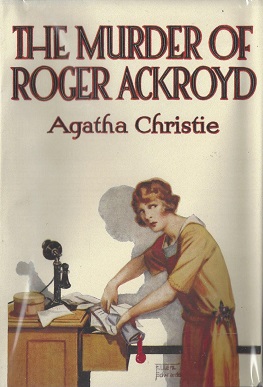
2017/27 Agatha Christie: The Murder of Roger Ackroyd (1926) **
Agatha Christie's books are reckoned to be the third best-selling titles of all time after the Bible and Shakespeare. According to Wikipedia, that oracle of co-operative encyclopedism, Christie published 66 detective novels and 14 short story collections. They have rather a good picture of her as a girl.
Guinness World Records lists her books as having sold 2 billion copies around the world and the Index Translationum (who knew?) states that she has been translated into 103 languages. Given this unassailable evidence of her global popularity, perhaps I was missing something. In my 20s I tried at least three times to read a paperback copy of The ABC Murders, only to cast it aside as a lot less than thrilling. Perhaps, in mature years I might enjoy one of Christie's most famous novels. I lashed out £2.99 to Google Play for the 377 page e book.
![]() |
| Cover of first edition hardback, courtesy of Wikipedia |
I finished the book quickly and I certainly did want to know who did it. So far, so good. This is a country house murder mystery, investigated by the Ackroyd family doctor and, improbably, by his next door neighbour, Hercule Poirot, who has, also improbably, retired to the country to grow vegetable marrows. And, to digress, why the prefix vegetable? Perhaps it distinguishes them from bone marrow. Christie was brought up in an upper middle class family in Torquay and paints a picture of prosperous villages and evening Mah Jong parties, attended by rambling Colonels retired from the Raj and gossip-hungry spinsters. One Ackroyd house guest is Major Blount, a big game hunter.
This is no doubt a world that she knew well, although by the time the book was published in 1926 she was living at Sunningdale in Berkshire . In December that year her husband Archie asked for a divorce to marry a younger woman, Nancy Neele. Agatha famously disappeared and was discovered in the Swan Hydropathic Hotel in Harrogate after front page press coverage in the UK and even in the New York Times.
Roger Ackroyd's story is told from the first person standpoint of Doctor Sheppard, revealing multiple motives and secrets of the protagonists, both the servants and the relatives who hope to inherit the wealth of this self-made manufacturer. Cocaine sniffing, illegitimate children and blackmail play their parts and this is clearly a staid world of haves and have nots, in which too many people have too little to do. The sense of resentment by the servants of their precarious social position is nicely realised. The story only comes alive when Poirot appears and he is certainly a creation of genius, even if his eccentric mode of speech is not always consistently applied. It is useful to have a detective who has licence to be abrupt and unconventional in dealing with the protagonists. I expect that the inverse is true of Miss Marple.
This story is cleverly put together, although the reveal has remained controversial, and Poirot is entertaining, but life is too short to eat bad food, drink poor wine or to read Agatha Christie. All the same I am always happy to watch David Suchet's outstanding portrayal of Poirot.
Friday, 9 June 2017
2017/29 Iain Bamforth: A Doctor's Dictionary (2015) ****
This collection of longer form journalism by a Scots doctor, poet, translator from French and German and lecturer in comparative literature is extremely varied, reflecting his many interests. It is assembled under the initial letters of the topics covered, probably for want of any other unifying theme. Bamforth is one of those extremely clever literary coves who happily wanders between science and the arts. Bertram Wooster would have recognised the type: noble intellectual forehead and the predominance of fish in the diet. Indeed several of his pieces stretched me to the limits of my slender intellect. His wife is German and he has practised as a GP in Strasbourg but he also describes the year that they spent in Broken Hill, including his visit to deep underground workings, the history of toxic dust and the dire climate. Broken Hill has been staggeringly profitable from the beginning and only this week I was reminded that Australia never suffered recession from the global financial crisis, largely because of the insatiable Chinese demand for its mineral reserves.
Bamforth loves Stendhal, Kafka, Thomas Mann, Rabelais and many others. An amusing chapter covers Kafka's fondness for his uncle, a country doctor and one of the first motor bike owners in Austria Hungary. Tuberculosis is another theme: its 19th Century associations with heightened sexuality and the Swiss sanatoria, as described in Thomas Mann's The Magic Mountain. This particular market for health tourism dried up fairly rapidly after 1943 when Albert Schatz discovered streptomycin. Researchers estimate that around a third of people on the planet have been exposed to TB and the incidence of the disease is higher than it has ever been in total numbers affected.
Essays also cover the importance of careful looking and the dominance of sight over the other senses, the impetus to the Enlightenment given by taxonomy and the illustration of anatomy, including the Plastinator, Professor Doktor Gunter von Hagens. The "von" is apparently an affectation on the part of this master showman whose gruesome tableaux of flayed humans and animals were included in spectacularly profitable exhibitions from the 1990s. This is a fascinating book and it is uplifting to find someone so continually curious and unwilling to be pigeonholed.
Bamforth loves Stendhal, Kafka, Thomas Mann, Rabelais and many others. An amusing chapter covers Kafka's fondness for his uncle, a country doctor and one of the first motor bike owners in Austria Hungary. Tuberculosis is another theme: its 19th Century associations with heightened sexuality and the Swiss sanatoria, as described in Thomas Mann's The Magic Mountain. This particular market for health tourism dried up fairly rapidly after 1943 when Albert Schatz discovered streptomycin. Researchers estimate that around a third of people on the planet have been exposed to TB and the incidence of the disease is higher than it has ever been in total numbers affected.
Essays also cover the importance of careful looking and the dominance of sight over the other senses, the impetus to the Enlightenment given by taxonomy and the illustration of anatomy, including the Plastinator, Professor Doktor Gunter von Hagens. The "von" is apparently an affectation on the part of this master showman whose gruesome tableaux of flayed humans and animals were included in spectacularly profitable exhibitions from the 1990s. This is a fascinating book and it is uplifting to find someone so continually curious and unwilling to be pigeonholed.
Monday, 5 June 2017
2017/26 Paul Beatty: The Sellout (2015) ***
This won the Man Booker Prize in 2016 and it is a novel of great wit, which riffs on being black, indeed being a nigger, raised by a social scientist father on an urban farm in Dickens, a ghetto community in southern Los Angeles. His father's harsh regime carrying out social experiments on his son provided some laugh-out-loud moments but overall it was mostly occasional wry smiles, rather a lacklustre response compared with those of the many well known fans cited over several pages. A clever writer but for me the book was oversold.
Friday, 2 June 2017
2017/25 John Grisham: A Time To Kill (1989+92) ***
Listless from a stomach bug, I lost myself in this John Grisham, an easy and compelling author for those under the weather. I was drawn on by the story but this, his first novel, left me unsettled. All the characteristic elements of his legal thrillers are here: beautiful anodyne wife, young lawyer battling the profession/other lawyers/the forces of evil, preppy fashion choices and so on. It sold reasonably well in the local area but no great shakes and was reissued with massively greater sales after the runaway success of his breakthrough novel, The Firm in 1991.
I came across that book as a giveaway in the days when P&O Properties encouraged me to travel to London First Class, on a service that was branded "Pullman" but in reality offered nothing close to that legendary standard. I had intended to work on the return journey but opened the free copy of the novel and was still reading when I reached Preston. Since then we have read perhaps a dozen of his novels when we felt the need for escapism. The combination of convincingly accurate legal procedure and compelling stories of the weirdness and venality of America are hard to resist. The solid but uninspired prose is easily forgiven. I couldn't write these novels and Grisham has been outstandingly successful.
The story is set in the 1980s and it is easy to forget that Martin Luther King's "I have a dream" speech was only 20 years' beforehand. The Jim Crow Laws were formally abandoned in 1965 and attitudes slowly changed. The novel assumes, no doubt accurately, that if a white father shot a black man for raping his daughter, he would be acquitted by a predominantly white jury. Grisham pushes to the limits the mirror image crime to see whether Mississipi has moved on sufficiently to acquit a black man of the same charges. Confrontation between highly organised black churches and the Ku Klux Klan wind up the tension, resulting in the mayor's being obliged to call in the National Guard. The oppressively humid July weather increases the tension further and flaming crosses, beatings, jury intimidation and the burning of our lawyer hero Jake Brigance's much-loved and carefully restored Victorian house set the scene for the expected tense courtroom drama.
It is perhaps 25 years since I first read this novel, although I have seen the Matthew McConaughey and Samuel L Jackson film since then. This time I found the prejudice and traditions of the South freshly shocking and although our lawyer hero Jake Brigance is comfortable with black folks and wants to fight for their rights, there is a strong sense that what matters most is winning his case and boosting his reputation. His attitude to women is traditional and he does not want a wife who is independent and career-minded. It is important for him to be the provider and he will bend the law and practice to win work and to win cases. This is not To Kill a Mockingbird and Jake is not Atticus Finch. He makes it clear that previous generations of small town lawyers used their position to accumulate money and property to the disadvantage of their clients and that old prejudices continue to die hard.
The book is too long at 515 pages and needed further editing. In the introduction to the 1992 reissue, the author writes that the novel is significantly autobiographical. His hero, Jake Brigance, is a small town Southern street lawyer. Grisham only practised law for ten years, in a small firm in Oxford Mississipi, where he was born and brought up. He is a man of the South. I came away with the feeling that Grisham is not too far from being a good ol' boy himself.
I came across that book as a giveaway in the days when P&O Properties encouraged me to travel to London First Class, on a service that was branded "Pullman" but in reality offered nothing close to that legendary standard. I had intended to work on the return journey but opened the free copy of the novel and was still reading when I reached Preston. Since then we have read perhaps a dozen of his novels when we felt the need for escapism. The combination of convincingly accurate legal procedure and compelling stories of the weirdness and venality of America are hard to resist. The solid but uninspired prose is easily forgiven. I couldn't write these novels and Grisham has been outstandingly successful.
The story is set in the 1980s and it is easy to forget that Martin Luther King's "I have a dream" speech was only 20 years' beforehand. The Jim Crow Laws were formally abandoned in 1965 and attitudes slowly changed. The novel assumes, no doubt accurately, that if a white father shot a black man for raping his daughter, he would be acquitted by a predominantly white jury. Grisham pushes to the limits the mirror image crime to see whether Mississipi has moved on sufficiently to acquit a black man of the same charges. Confrontation between highly organised black churches and the Ku Klux Klan wind up the tension, resulting in the mayor's being obliged to call in the National Guard. The oppressively humid July weather increases the tension further and flaming crosses, beatings, jury intimidation and the burning of our lawyer hero Jake Brigance's much-loved and carefully restored Victorian house set the scene for the expected tense courtroom drama.
It is perhaps 25 years since I first read this novel, although I have seen the Matthew McConaughey and Samuel L Jackson film since then. This time I found the prejudice and traditions of the South freshly shocking and although our lawyer hero Jake Brigance is comfortable with black folks and wants to fight for their rights, there is a strong sense that what matters most is winning his case and boosting his reputation. His attitude to women is traditional and he does not want a wife who is independent and career-minded. It is important for him to be the provider and he will bend the law and practice to win work and to win cases. This is not To Kill a Mockingbird and Jake is not Atticus Finch. He makes it clear that previous generations of small town lawyers used their position to accumulate money and property to the disadvantage of their clients and that old prejudices continue to die hard.
The book is too long at 515 pages and needed further editing. In the introduction to the 1992 reissue, the author writes that the novel is significantly autobiographical. His hero, Jake Brigance, is a small town Southern street lawyer. Grisham only practised law for ten years, in a small firm in Oxford Mississipi, where he was born and brought up. He is a man of the South. I came away with the feeling that Grisham is not too far from being a good ol' boy himself.
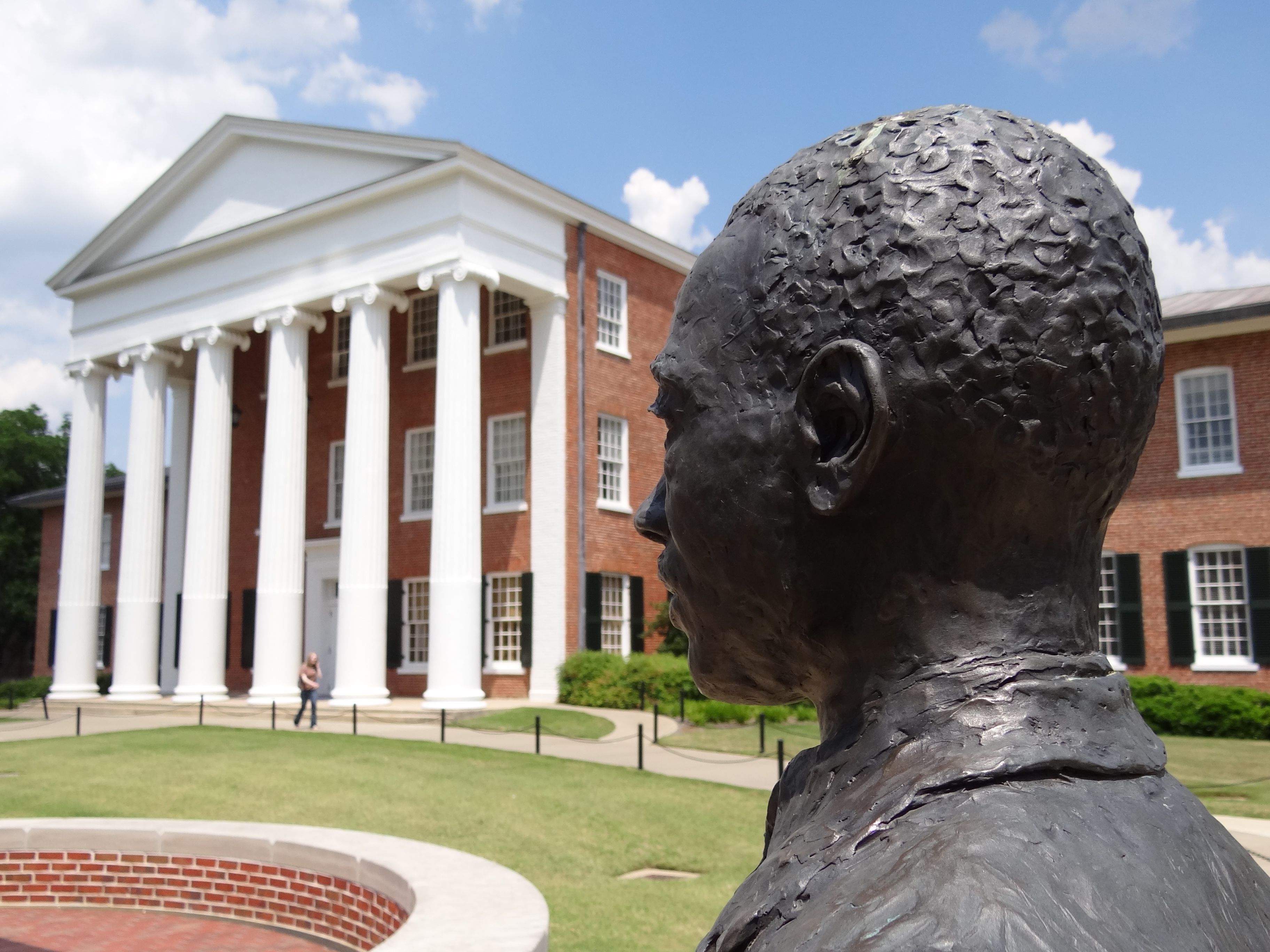
Ol Miss, Oxford Mississipi, monument to James Meredith who desegregated the university.
Image courtesy of Wikimedia Commons
Subscribe to:
Posts (Atom)