
Guinness World Records lists her books as having sold 2 billion copies around the world and the Index Translationum (who knew?) states that she has been translated into 103 languages. Given this unassailable evidence of her global popularity, perhaps I was missing something. In my 20s I tried at least three times to read a paperback copy of The ABC Murders, only to cast it aside as a lot less than thrilling. Perhaps, in mature years I might enjoy one of Christie's most famous novels. I lashed out £2.99 to Google Play for the 377 page e book.
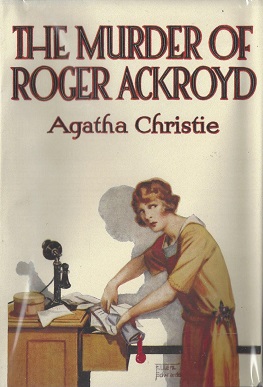 |
| Cover of first edition hardback, courtesy of Wikipedia |
I finished the book quickly and I certainly did want to know who did it. So far, so good. This is a country house murder mystery, investigated by the Ackroyd family doctor and, improbably, by his next door neighbour, Hercule Poirot, who has, also improbably, retired to the country to grow vegetable marrows. And, to digress, why the prefix vegetable? Perhaps it distinguishes them from bone marrow. Christie was brought up in an upper middle class family in Torquay and paints a picture of prosperous villages and evening Mah Jong parties, attended by rambling Colonels retired from the Raj and gossip-hungry spinsters. One Ackroyd house guest is Major Blount, a big game hunter.
This is no doubt a world that she knew well, although by the time the book was published in 1926 she was living at Sunningdale in Berkshire . In December that year her husband Archie asked for a divorce to marry a younger woman, Nancy Neele. Agatha famously disappeared and was discovered in the Swan Hydropathic Hotel in Harrogate after front page press coverage in the UK and even in the New York Times.
Roger Ackroyd's story is told from the first person standpoint of Doctor Sheppard, revealing multiple motives and secrets of the protagonists, both the servants and the relatives who hope to inherit the wealth of this self-made manufacturer. Cocaine sniffing, illegitimate children and blackmail play their parts and this is clearly a staid world of haves and have nots, in which too many people have too little to do. The sense of resentment by the servants of their precarious social position is nicely realised. The story only comes alive when Poirot appears and he is certainly a creation of genius, even if his eccentric mode of speech is not always consistently applied. It is useful to have a detective who has licence to be abrupt and unconventional in dealing with the protagonists. I expect that the inverse is true of Miss Marple.
This story is cleverly put together, although the reveal has remained controversial, and Poirot is entertaining, but life is too short to eat bad food, drink poor wine or to read Agatha Christie. All the same I am always happy to watch David Suchet's outstanding portrayal of Poirot.

No comments:
Post a Comment