I came across that book as a giveaway in the days when P&O Properties encouraged me to travel to London First Class, on a service that was branded "Pullman" but in reality offered nothing close to that legendary standard. I had intended to work on the return journey but opened the free copy of the novel and was still reading when I reached Preston. Since then we have read perhaps a dozen of his novels when we felt the need for escapism. The combination of convincingly accurate legal procedure and compelling stories of the weirdness and venality of America are hard to resist. The solid but uninspired prose is easily forgiven. I couldn't write these novels and Grisham has been outstandingly successful.
The story is set in the 1980s and it is easy to forget that Martin Luther King's "I have a dream" speech was only 20 years' beforehand. The Jim Crow Laws were formally abandoned in 1965 and attitudes slowly changed. The novel assumes, no doubt accurately, that if a white father shot a black man for raping his daughter, he would be acquitted by a predominantly white jury. Grisham pushes to the limits the mirror image crime to see whether Mississipi has moved on sufficiently to acquit a black man of the same charges. Confrontation between highly organised black churches and the Ku Klux Klan wind up the tension, resulting in the mayor's being obliged to call in the National Guard. The oppressively humid July weather increases the tension further and flaming crosses, beatings, jury intimidation and the burning of our lawyer hero Jake Brigance's much-loved and carefully restored Victorian house set the scene for the expected tense courtroom drama.
It is perhaps 25 years since I first read this novel, although I have seen the Matthew McConaughey and Samuel L Jackson film since then. This time I found the prejudice and traditions of the South freshly shocking and although our lawyer hero Jake Brigance is comfortable with black folks and wants to fight for their rights, there is a strong sense that what matters most is winning his case and boosting his reputation. His attitude to women is traditional and he does not want a wife who is independent and career-minded. It is important for him to be the provider and he will bend the law and practice to win work and to win cases. This is not To Kill a Mockingbird and Jake is not Atticus Finch. He makes it clear that previous generations of small town lawyers used their position to accumulate money and property to the disadvantage of their clients and that old prejudices continue to die hard.
The book is too long at 515 pages and needed further editing. In the introduction to the 1992 reissue, the author writes that the novel is significantly autobiographical. His hero, Jake Brigance, is a small town Southern street lawyer. Grisham only practised law for ten years, in a small firm in Oxford Mississipi, where he was born and brought up. He is a man of the South. I came away with the feeling that Grisham is not too far from being a good ol' boy himself.
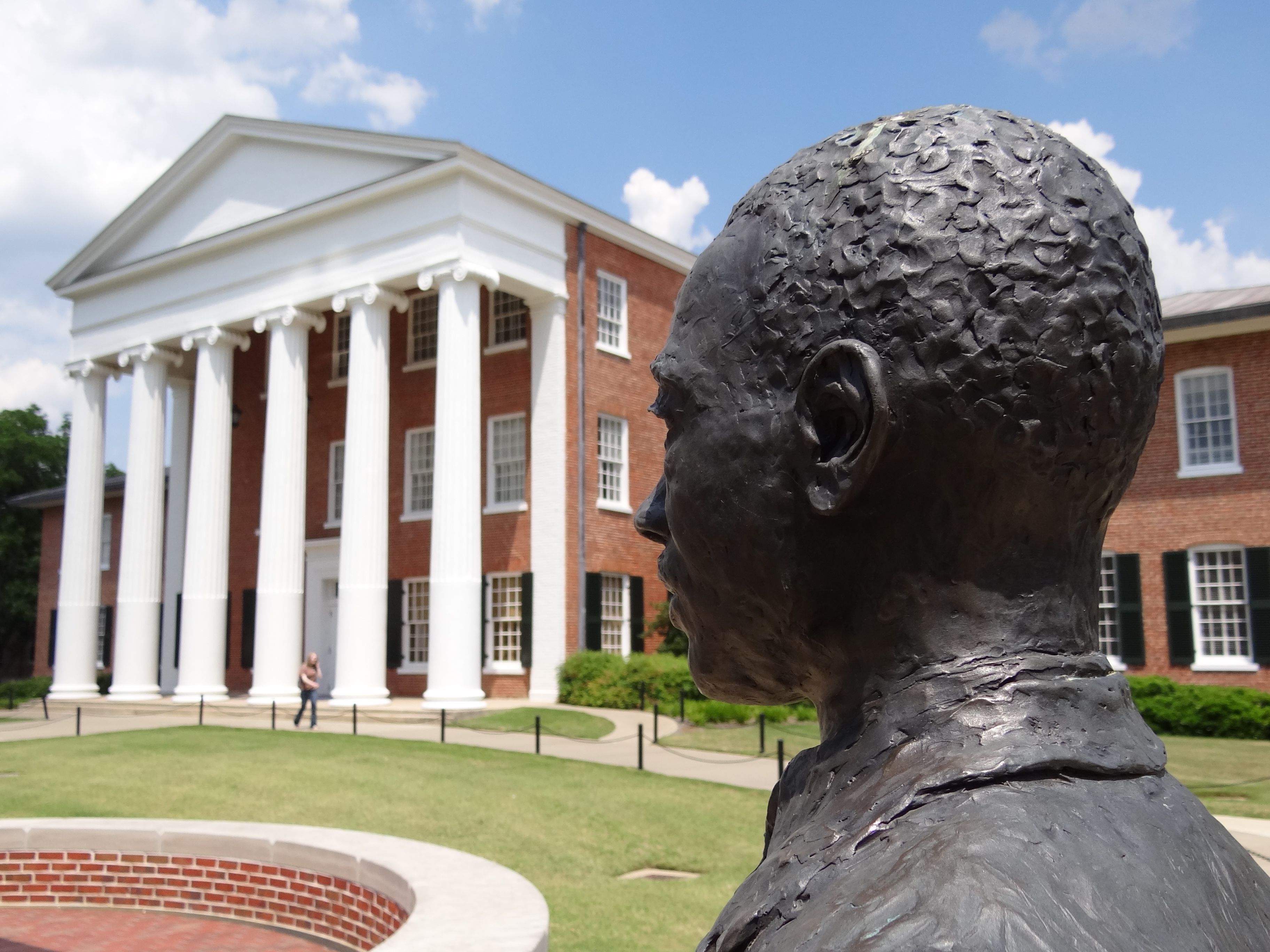
Ol Miss, Oxford Mississipi, monument to James Meredith who desegregated the university.
Image courtesy of Wikimedia Commons

No comments:
Post a Comment